 7:54
Closer look at the Gemini GVX Powered Speaker
Contents of the video
0:00 It's not rocket science to be quite honest
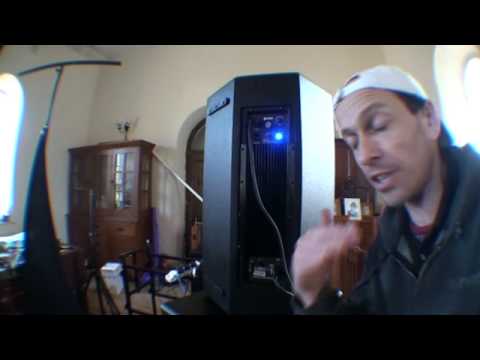
In this video we're looking at this guy from a company called Gemini, it's known as the GVX series. And this particular guy is a 15 and horn, it's what's known as powered. There are two amplifiers in here, one is for the 15 inch driver, the other one is for the compression driver at the top. Now what I'm going to do, I'm just going to turn it around like that so we can see the back. Now, it's not rocket science to be quite honest. You have power on off, fuse, That there is in relation to the power supply, so it's best not to touch that. And you have the pokium bit there for your power. Heat sink, input and output. Input from your mixer, output into another one, into another powered speaker if you want. Game control, which is another word for volume control. And this thing here, which is 100Hz, which is short for Hertz, low cut filter. And we have what's known as monitor and full range.
Well, how can I explain? If we have it at full range, it basically means that this speaker will produce the full range of sound. If you flick that up to monitor, what happens is it will do all the high sounds and come all the way down to 100Hz and then stop. It won't do anything below 100Hz. Now, to a certain degree that's good and bad. It's good on the basis... Let's say the speaker itself will be more efficient. In other words, when you've got loads of bass coming out, the actual 15-inch speaker itself will be moving like that to try and capture all that bass sound. So on that basis, it's more efficient because the speaker is doing less movement. The only disadvantage, of course, you don't get that really sub-low bass.
2:23 At the moment, it's on monitor
But if you've got some powered bass cabs or some other bass cabs just using an external amplifier, then they're the ones, they're the items that can do the low sub-bass. So in a sense, by switching it to monitor and having it working at 100Hz and above means that the bass cabs then can work 100Hz and below. So what I'm going to do now, by the way, the tune I'm using, love this track, Sean Christopher, Make My Love, and it is the Stones Essential Mix. It's a stomper. Here we go. Now at the moment, it's on monitor. And because of course you're listening to it, there's a little speaker on the top. What you want to do is you want to set your mixer so it's working, so in other words, the mixer, all the LEDs on your mixer aren't going into the red or anything like that. They're in a good, steady, even, flat response. So what I'm going to do is step down. Not going in the red.
Until it hits the red limit. At that point, when it starts to flash, I'm going to just move it back down a little bit. So theoretically now, I know I've got what's known as a bit of headroom. What is headroom? It's got nothing to do with the room you've got in your act. I'll tell you what it's to do with. Let's imagine you have a box and you fill that box full of stuff and you ram it full of as much stuff as you possibly can until there's no more room in that box. And let's say all of a sudden something else comes along and it has to go inside that box, but guess what? It can't because there's no room. But on the other hand, let's imagine you've got the same box and you ram it full of stuff, but only say three quarters of the way full. Then all of a sudden you need more stuff to go into that box and it can, it can get in there. Now that's in a way...
5:18 There's an extra area for the amplifier to push out some more stuff
A sort of a way of looking at headroom, because you've got your speakers, you know, everything's chugging, everything's moving on quite nicely. And then all of a sudden, you know, you will have a certain part of the music where the bass or the high, what happens is that sound can get in there and go, because you've got headroom in the amplifier. In other words... There's an extra area for the amplifier to push out some more stuff. So, or have more stuff in the box kind of thing. Right, so if you imagine, if that was on there where you saw it flashing and I started to turn that up again, it would flash, flash, flash even more, maybe stay on and at that point we're at limit. That is telling me the amplifiers are saying hold back a minute, we're doing what we can, we can't do any more as opposed to...
Turning it down and they're going, oh my goodness. In other words, the oh bloody hell and my goodness is the little bits of bump that you're sort of pushing at them as opposed to turning it, oh bloody hell, oh god, oh it's too much, turn it down. Right, okay, so, random. Can do what's known as become a wedge and I'll show you. I don't normally do this sort of thing on speakers but there you go, like that. So in other words if you're a band member or anything like that you can use them for monitoring wedgie style purposes and the terminology wedge, I can't answer that. Anyone know what terminology wedge is? It's something you've always said. Oh look Can we have some wedges in front of us? And, you know, no one's all of a sudden going to give you a piece of cheese, are they? They're going to stick a speaker in front of you. So... All I can say about the sound, there is an element of bass there, logically, because it's full range, but the tops are nice and crystal with the element of je ne sais quoi. OK. Anyway, bit of a demo on these guys here. The GVX series from Gemini. Practice and enjoy. And remember...
Watch your ears because they're the only ones you've got. Pardon? Practice and enjoy.
This transcript was produced automatically from the audio of the video and may contain mistakes.