 11:31
Ev S200 Pasive VS Ev EKX-12P Powered the Old School VS New School
Contents of the video
0:01 Cameras rolling and here we go
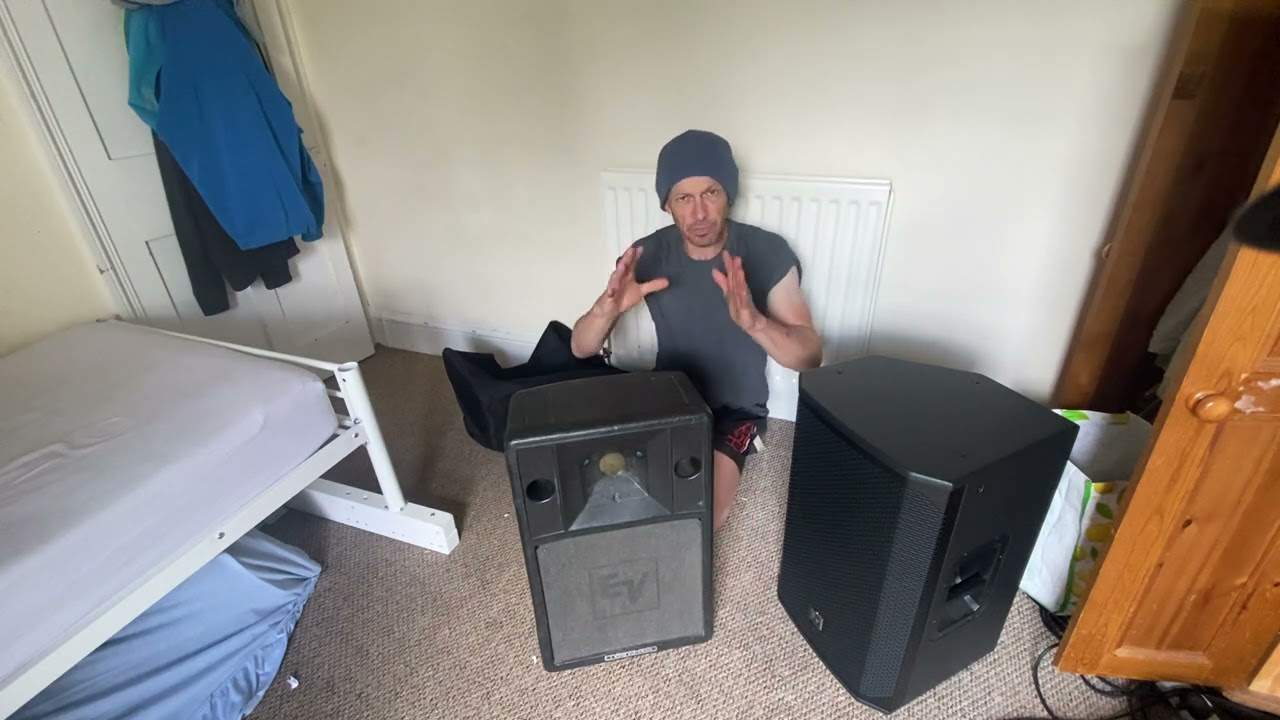
Right, cameras rolling and here we go. Right, ladies and gentlemen, first of all my disclaimer. I haven't been paid to make this video and these speakers, I bought them. So I went to a shop and I paid money for them. Still got the receipts. Of course there's one each but I bought two of them. And both of these cabs are, I believe, well that definitely is not a new model. This is relatively new, but it quite possibly could have been superseded. But what I want to talk about here mainly is the company called EV. Now they haven't paid me for this promo or to do this video, nothing. Like I said, I've just bought these cabs and there's good reason for them. And they were, if not definitely one of the first companies who manufactured a speaker that was made out of plastic. And it was revolutionary. Now the S200, anyone who knows these speakers will know that they are, they're not indestructible, but they've not only got the EV quality, but the sound and clarity of them is just outstanding.
2:17 You've got a hole there so you can pole mount it from the side
So what you've got is you've got a 12 inch down here and you've got a two inch compression driver. Now when we talk about the compression drivers, when you hear some people saying like quarter inch, half inch, one, two, two and a half, it's the actual throat. So it's the hole where the sound comes from. And this is two inch. Now, I've opened these up in the past and the magnets are massive. Now, the size of this, OK, if you look, they're roughly about the same height. So I'd say if I got a 12 inch single, they're probably, you know, 24, 25 inches high. All the spec is on the web anyway. And you can see on the S200, it's relatively thin. It's been battered about. You've got a hole there so you can pole mount it from the side. Also, you've got one at the bottom and what this, hold on, let me see, it shows how old they are because that's bent but it doesn't really matter. And also there used to be a clip here where you used to have a piece of metal and you could screw that in to a little screw hole there and use it as a wedge monitor.
Now, I remember in the 90s, the mid-90s, having four of these and working four of these. I had two aside on an amplifier. Each one of these is eight ohms. You put two together, you go down to four ohms. The amp was four ohms and I was running a set of, I think they were Ohm BR218s, bandpass cabs, which... They were just amazing. You had two 18-inch drivers, they were known as triple chamber, so what they did is they just gave out this low toneful bass and still to this day I've yet to find a bass cab personally that has the same sort of tuneful deep melodic sound as they had. In fact, if I found a couple going online, even though I haven't got space in my car, I'd probably buy them just to have them. So they are OHM BR218. So Google that if you want to. But these here are the S200s. Now what I might do is, first of all, before I continue there, these are great for mid and top. You know, fantastic.
For, you know, vocalists, artists, guitarists and so on. But then if you want to start thumping a load of bass through them, what happens is they do vibrate. Now, again, when these first came out, great cabs. And on the back, you had two quarter inch jack inputs. Now you can see here that they're speak-on. Now practically every single person who had these changed them to speak-on All XLR. XLR to begin with, then Speakon because XLR came out before Speakon. Because what would happen is Because there was so much vibration, the jack inputs would eventually wear away because the jack sometimes would fall out because there was so much vibration here. And you've got a switch here so you can go with or without EQ. So it just gives the high frequency a little bit more pizzazz.
5:07 It was the S200s as well as the base cabs
It was the S200s as well as the base cabs. So what I've done, I've got a set of these. Now these are the wedge style and the model is EKX12P. Now I've plugged them in, turned them on and again EV quality. Absolutely outstanding. So you're probably wondering why I've got these. The thing is, is that like a lot of people, when you're in the DJ industry, PA, you know, you start off buying loads of expensive kit. You know, you want the biggest sound system going, excuse me, you want five million bass cabs, a couple of mid and top, so you can play some serious sort of dub or drum and bass. You get the biggest van possible and you end up realising at the end of the month, you've spent more money than you've made.
6:54 H&H tents aren't any good
Just to boost your ego because you want it all big and brass but then as you get a little bit older you realize well um do you really want to start carting loads of kit around so what i wanted to do was get some kind of system that i knew would push To an extreme, not break my back and at the same time look good. That's why I've come back to some EV. Now, I've still got the Tentsaw series from H&H, the 12-inch, but even though they are great cabs, I would hazard a guess to say that you'd have to have two of those next to each other to just about manage to match one of these. And that's not to say that the... H&H tents aren't any good. They are very good, but it's about price, isn't it? At the end of the day, if you're going to spend a lot of money, yes, you may be spending some of that money just on the make, but then with PA systems, not hi-fi that you'd have in your house, but proper PA systems.
If you want to get good quality sound and you want to get something that's got a lot more welly to it, you're going to have to extend that budget a little bit more. Now, 12 inch like this, I would happily use this in front of say 100 people. But I wouldn't want to start playing a whole bunch of drum and bass and dubstep because even though you would be able to play that, you're not going to get that depth and the energy if you had say a set of 15 subs or twin 18s. But at the same time, if let's say you're just doing a regular wedding disco and you want something to look very neat, not cluttered, then, you know, a set like that is fine. Now, alternatively, you know, another reason why I bought these, and by the way, very quickly, these are active, so they have internal amplifiers in there. The S200s are passive, so there's no amplifiers.
9:14 Watts, were running, these were
So my intention in the future is to get maybe one single 18 or one single 15 or maybe two single 12-inch bass cabs, again passive, also with internal crossovers and 8 ohms each. So if I've got an amplifier that runs each side at 4 ohms then I'll go from the amp into one of the bass cabs Out of the bass cab, into the S200 and then the same the other side. And that should give me four ohms a side which will match the amplifier. Now these, I can't remember what do they do? Okay, power capacity 300 watts. Now long-term average. Now back in the day when it said 300 watts, it meant it. Something that I don't like, and please leave a comment based on what I'm about to tell you now, if you're finding the same as I am, is that a lot of speaker manufacturers now say 1000 watts output, 2000 watts output. But it's very difficult to find the true output. And one number or one phrase you need to look for...
Is the rms so for example you could have a speaker system and it could say a thousand watts but if it's got like pmpo or peak power that means that it will take a thousand watts but for like a millisecond if you had an amplifier and you pushed a thousand watts into that pa system all night it wouldn't happen because probably after about two or three minutes you'd have silence whereas this You could put 300 watts into it, and like it says, average. So like I said at the back, long-term average power capacity is 300 watts. So the average, 300, 280, 290, but the average is 300, so you could probably go to 320, 330, but you'd have to stick around the 300. And again, I wouldn't want to put loads of sub-bass into these.
I remember back in the day, I had a crossover, a Peavey crossover as well. And I made sure that these were running around about 100 hertz and above. The bass cabs were running 100 hertz and below. So the bass was doing the sub. These were doing the mid and top, which means I had a lot more efficiency with the cab and also a better quality of sound. So there you go, ladies and gentlemen. Like I said... Leave some comments, let me know what you think. Do you prefer passive or active? Have you got a whole bunch of PA system? Maybe you're like me now, you had masses of PA in the past and now you're happy with a better back and a couple of speakers. Don't forget, please leave some comments, like and subscribe, hit the notification bell and all that sort of stuff. Practice and enjoy. Thank you.
This transcript was produced automatically from the audio of the video and may contain mistakes.