 17:59
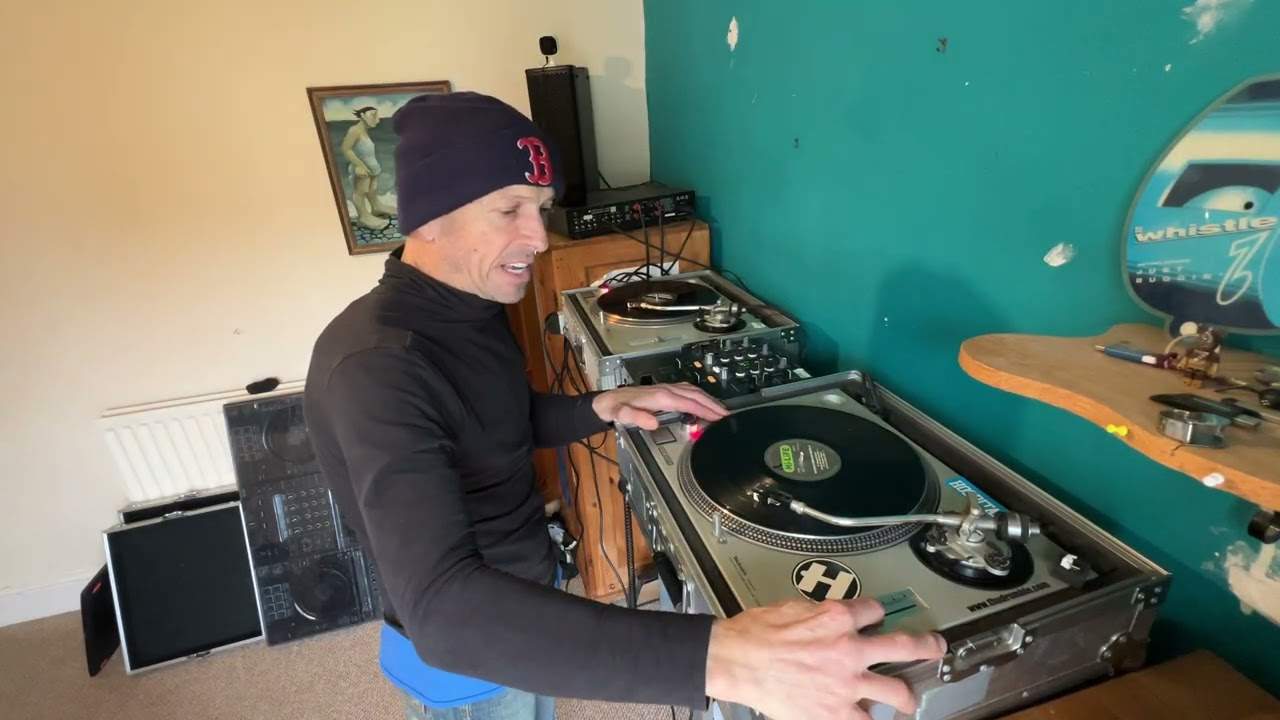
In Depth DJ Beat Mixing Lesson Demonstration Using Only Vinyl No Headphones
Contents of the video
0:01 I'm going to run through some of the basics of mixing using vinyl
Right, ladies and gentlemen, I'm going to run through some of the basics of mixing using vinyl. So before I start, if you've never used vinyl before and you're predominantly a laptop stroke controller DJ, and that's how you've been brought up, I highly, highly recommend that you have a little go on vinyl. If you're used to using controllers and you're used to looking at a screen, looking at the BPM, looking at the key, and just really letting the computer do a lot of the work, then you're missing the whole soul, I personally think. Let me know in a comment of real DJing because 30 years ago people didn't really use laptops. Well, maybe if you were very, very lucky. But now it seems that everyone's got a laptop and again, I don't really want to talk about this too much. I will in a future video, but I'm not really one who likes even DJ sees vinyl, but use DBS virtual vinyl because if you're going to get a set of turntables, you might as well buy original vinyl because that's the whole point.
Okay, you're using... No, let's not go there. All right, let's do that for another day. Anyway, I've got Wildchild Renegade Master and I've got Thomas Banglaterre's Spinal Scratch on Rule Records, original vinyl, and these two tunes are just immense. If you know these tunes, in fact, I'll play a little bit, not going to play too much of the track itself because, of course, I don't want to get copyright restrictions. There you go. You get the general idea there and then the Rule Record Spinal Scratch, it's just one of those mind blowing house beats. It's almost like a break stroke house beat, but check it out.
2:21 And talk you through the process
The reason I've got these two is because what we're going to do, we're going to mix by ear, no headphones, and we're just going to use the two tracks. And the beginning of this track here, the reason being is because there's a hand clap. So what I want to do is I want to show you and talk you through the process of learning how to beat match by ear. So firstly, I've got the two tracks on the center position and we'll start that one off. And let's just find the beginning of this.
Okay, we don't want that bit.
All right, that's the end of the last track and I want to get it to where we have a clap.
There it is now with the Renegade Master and this particular mix, the clap starts on the two, four. So again, you've got to be very careful here and you can't make mistakes. Again, if you're using a laptop, you could see the grid. You may have to move the grid to make sure that you're on the two instead of the one, because if you used this from a laptop, the software may think, oh, there's a hand clap that could be the count of one, which it isn't. It's actually the count of two. So one clap, three clap and so on. Okay, so I've got the pitches set to the center position to begin with, and I'm just going to throw Renegade Master in at the right time signature. But I'm not going to beat match them and let's see how long it takes before they start sounding terrible.
And again, I'll use the faders accordingly. Well, I'll use the faders so we can get a good idea of which sound is which, because again, with vinyl especially, you need to be careful about using your up faders. Because if you just have them both all the way to the top, one of the tracks could have been recorded at a lower level than the other one, so you may have overpowering. But for this demonstration, I do want to more highlight the Renegade Master over Spinal Scratch. Because the idea is to use Spinal Scratch as like the back beat for us to mix the Renegade Master into. So here we go.
4:59 I'm just going to bring it up to like two and a half
Okay, so already we can see that it's offbeat and it's too slow, I should have just...
So what I'm going to do, I'm just going to speed it up. I'm just going to bring it up to like two and a half. Now you could, if you want to, bring it up in increments of say one... Let's have a look. You've got different spaces, so you've got one, two, three, four, five, I believe that's a percentage based on the pitch being plus or minus eight percent. Now again, this isn't really a science for these two records as such, but it is a science when you're beat matching any track. I'll explain. Let's say one track is 120 BPM and the other one's 130 BPM. Well of course, if you start them off at the same time, the difference is going to be very noticeable very soon. On the other hand, if one track is 120 BPM and the other one is say 122 BPM, then technically they may sound as though they're not offbeat to begin with.
But sure enough, over time they will start to sound offbeat. And again, if I relate to the video I did years ago that people still love and I think it's one of the best in the world of the cars. If you imagine BMW and an Audi, BMW is going at 30 miles an hour, the Audi is going at 32 miles an hour. From the point of view of people watching or let's say you've got a drone above them following them, you're not going to notice much of a difference in distance that they travel for quite a while. Simply because there's only a two mile an hour difference between the two of them. On the other hand, if one is going at 30 and the other one is going at 40 miles an hour, then of course you'll notice a difference in the distance
7:43 I hope that makes sense
They've both travelled in relation to each other quite soon. So where that's concerned now, what I'm doing here, I've worked out that the Renegade Master is too slow. So if it was very slow, I would be increasing the pitch quite dramatically. But because it's not that slow, I'm going to be increasing the pitch a tiny bit. Now I hope that makes sense. A bit of a mouthful but if you rewind, hopefully there's some logic there. So let's get this ready again. There it is. Still off another one, try again. Now it's starting to sound better but it's still not quite there. Bring it back, up another one, start again.
We're so close. Well, not close-close but I think I started that too early. Let's spin that one back and let's start the spinal scratch again. Okay, so when you get to a place where you think it's close, this is when we can do what's called ride the pitch. Now again, I don't know if I was the one who invented that saying, I'm not sure, but I have been using it since about 1587. Actually 1588. Can't really say that early. Alright, so I've got it very close now. So what I'm going to do now is I'm going to start working the pitch, maybe decrease slightly, increase slightly. So if we take my moves into the analogy of the two vehicles, let's say for example, now this is the key here. You've got again, you've got an Audi and a BMW.
Now the Audi driver knows that they are going 30 miles an hour but the BMW driver has no idea how fast the Audi driver is going.
10:21 This is the track that doesn't know how fast the other one's going
So what's happening here, now imagine for example that is the Audi driver spinal scratch and the BMW renegade master is the car. This is the track that doesn't know how fast the other one's going. Now the only way we're going to get this one, this track at the same speed as the other one is by, if you imagine the cars again, you've got your foot on the gas and you're moving your foot on the gas. You're increasing, decreasing the pressure on the gas to make sure that first of all maybe you catch up. Once you caught up, you slow down. So for example, if this car here isn't going fast enough and the other one's going too far ahead. So for example, that one is going 30 and this one's going 25 and the guy going 25 realises I'm going too slow.
If they keep to 25, they will start to go back. They'll lose the distance in between the two of them. It'll get greater and greater. But if let's say this car knows that the other guy's going 30 miles an hour and they decide to go 30 miles an hour when the other car has taken quite a move forward then you're always going to have exactly the same amount of gap because what's happening is this car here has gone 30 miles an hour. This car's gone 25 say for five seconds and after that five seconds, if this car now goes at 30 miles an hour you're always going to have that same amount of a gap for the time they carry on driving. So what needs to happen is this vehicle needs to go 35, 36 miles an hour to catch up.
12:45 Speedo, you're going I'm going 30
As soon as it's caught up then it needs to reduce the speed back down. Now if we take that analogy to tiny moves on the pitch basically what you're doing is as soon as the two cars meet up and again don't forget the Audi knows how fast they're going the BMW doesn't. The BMW being this track here. What this track, this car is trying to do is trying to work out exactly how fast by gas slightly on off on off so it's a kind of real tiny moves on the throttle on the gas till eventually you get to the position where you can hit cruise control and once you do that you look at the speedo, you're going I'm going 30 miles an hour. Now again with mixing vinyl the difference between this and a controller is a controller you have the sync button
You press that and the software will lock it into position with vinyl it is slightly more difficult it can be done based on a lot of things like your skill level your ears and also how accurate the pitch is on the turntable because over time the pitch can wear away it's all analogue this is why I said at the beginning of the session it's so good for new DJs to try something like this because it's not as easy as you think okay so we're very close so again I'm going to start this off
Start here
Alright so again I don't want to play too much just in case we get copyright issues but if we have a listen
It's still there I'm going to just leave it I'm not going to touch it, not touch the pitch nothing at all and let's just see what it's like
Still there, not going to touch it
Okay so starting to go off now it was starting to go off slightly there but let's be honest if you're doing a transition with vinyl for that matter with any kind of format really what you're looking at is a minimum of a two bar transition which is the count of four twice ideally you maybe want to do like 4 bars, 8, 16 I reckon we could have gone away with 16 bars there but you did notice the last time I played the two tracks you could hear they were starting to go off but again not using headphones and not using speakers what I will do though I'll finish this video off with something that's really interesting and also is a bit of a caveat so it may help you to the next level I've talked about this before and I'm going to ram this down people's throats
What you want to try and do and ideally this is great if you've got exactly the same piece of vinyl so if you have what you can do to practice is set your pitches to the centre position like so and you have the same vinyl either side, the same mix everything but what you do on your right hand vinyl you take out the left RCA from the back of your mixer and the left hand vinyl you take out the right RCA from your mixer so what you've got in essence now you've got one turntable playing the turntable on your right only coming through the right speaker and the turntable on your left only coming through the left speaker and then again it's a little bit haphazard you've got to be you've got to like watch what you're doing needle on the record
Right at the beginning press play start same here press play start and then start them both together so what you'll have you'll actually have the track in its entirety but you're playing the right deck on the right side the left deck on the left side and then start messing around with the pitch have a go a lot of it is about making up your own mind no I'll start again a lot of this is personal about your personal experience on how and what is the best way for you to mix ok now again please leave some comments let me know what you think about this video don't forget to like and subscribe because a lot of people don't subscribe thank you for watching I'm going to go around the back of the camera now because it's an iPhone
So much easier just uploading like this practice and enjoy thank you
This transcript was produced automatically from the audio of the video and may contain mistakes.
Related videos
-
Complete Beginner DJ Lessons Tags Key BPM Etc
A more advanced lesson folded in early, and worth doing once rather than putting off, because everything it sets up gets used for years…
-
Complete Beginner DJ Mixing Lessons Video 19 Getting Your Kit Ready for an Easy Mix
A whole lesson on getting ready, which is the right call - the exercise in the next video only teaches anything if the two decks are…
-
Complete Beginner DJ Lessons Video 9 Setting up a Cue Point and Using the Play Button
Short, and it covers a piece of behaviour that will confuse you exactly once if nobody explains it. The normal case Load a track and the…