 16:06
Interview with Johny Moris part 2 March 2010 Aberystwyth Ceridigion
Contents of the video
0:00 Orange amplifier, johnny morris, emperor roscoe
Right guys, I've just been to pick up the twin turntable from Borth and it's in pretty rough condition actually. In fact it's in very rough condition but maybe it needs a clean, I don't know. And we're going to go into Aberystwyth now and we're going to have part two of the interview with Johnny Morris himself. So... I've taken a bit of a gamble to a certain degree because I don't know what sort of condition it's going to be in, whether it'll even light up. Bearing in mind it's been stuck in a shed for goodness knows how long, who knows. But the main thing is it's got a lot of history behind it, a lot of history. Emperor Roscoe used to use it. You know, we're talking about something that was built in the 70s and the actual turntables were exactly the same turntables that were used in Radio 1.
So, we shall see. Let's have a word with Johnny Morris. Right, got a wide angle lens on again. We're back here with Mr. Johnny Morris, spot on disco. Now that particular deck as you say was made in the 70s and we're going to have a look at it later. It looks a bit rough but like you said it needs a damn good clean doesn't it? As long as it gets a good clean you're okay then. Yeah. But what happened was Emperor Roscoe, he was doing a lot of outside work around the country. Yeah. And he wanted a good deck, and he knew this guy called Matt Mathias up in Huddersfield. Yeah. Who originated the Orange Amplifier. Yeah. And he was the man behind the Matt Amp and the Orange Amplifier with groups. Okay. So he had him build three units. One for Dave Lee Travis, one for Emperor Oscar, and I had the other one. So they are, in a sense, they're virtually unique? Yeah, they are.
2:45 ...down in the south coast, down Plymouth Way
He wanted something made that was unique and which could be played on any dance floor in the UK. And so Emperor Roscoe then used, he got them made, three of them made by Matt Matthias because he invented the Orange Amplifier. Cliff, who used to be in London, he was the front man for Orange and he made the Orange speakers. This is crazy. ...down in the south coast, down Plymouth Way. And we're working in... and they've got very narrow country roads down there. And I drove Roger Daltrey down there, and a friend of mine was driving Keith Moon. His name is John LeWig. And he had a Bentley, and Roger had a P1800 Volvo sports car set up. And we were playing cops and robbers on the country roads. And Keaton was hanging out of the window with a shotgun, trying to blow up our tyres. And they were doing skids around the... So literally he was shooting at...? At our tyres, yeah. My God! Yeah, and he was trying to shoot, of course. He was so stoned that he kept missing. I don't think that's a bad thing, actually. Do you reckon this was a prequel to The Sweeney? Well, I don't know, but it could well be because...
I was only 18 then, and we had some great friends. Because I was staying with Roger Daughtry up in London, up in Maida Vale, where he had a flat. And I used to come back and forth to Wales and go back and help him do the driving. Because in those days, The Who were on the point of breaking up. And they were managed by Kit Lambert and Chris Stamp. And of course there were big ructions between The Who and they were all falling out of each other. The band nearly disbanded. It is Roger that kept them all together, favourite to Roger. Roger has worked very hard and I saw him last year in Swansea doing a show and talking about the old times but you know he's a very down-to-earth person. Yeah he sings it because he had a stutter didn't he? But then he very rarely stuttered when he was singing. That's right and he has a terrific voice and his voice seems to have held very well compared to other singers.
And one of the original, but he's a hard worker and he's done a lot of tours of the States and it's hard work doing all those shows. He was doing about two hours, three hours on stage and I saw him in Dallas one year, went down to see him in Dallas and oh, it's incredible the stamina that he's got. Right. And he's always been energetic, he's always been that type of person. Yeah, I think it's good to do that. You should get up more and do stuff. Oh, no, no, I'm past it now. What we all find, we're all slowing down. Right. We used to hang around the King's Road in Chelsea a lot. OK. The Chelsea Potter. And some friends of mine, one of them followed me up the other day, Viv Prince, used to be with the Pretty Things. And I used to be quite friendly with him and we always used to be around the London clubs. And we used to go down to John Lennon's house a lot.
5:32 What were the clubs like then?
What were the clubs like then? Different to what they are now. The club scene started with the Ad Lib in London, which was in Leicester Square. You go up on the fifth floor and you can see the morning break. And you used to sit there, you saw the Rolling Stones, the Beatles, Beach Boys, everybody used to make for there. And all the groups, when they finished, wherever they were in the country, to come back to Leicester Square, go up, and we always used to meet there about one, two o'clock in the morning. That's a club that used to sort of thrive on superstars. Yes. And we were just friends, you know. Rock and roll was just starting then. Before the Led Zeppelin days, before all these heavy music days. This was the beginning of the Stones and the Beatles. We were all young, we didn't know what was happening. And everyone, groups, Manfred and Man, they all seemed to come back. The Adlibs was one of the first clubs in London. I'm parked on a yellow line. The Adlibs was the first. Then you had the Speakeasy, which another club opened.
Then you had the Scotch of St. James, where we all had our names on the seats. But you know you say club? Again, people who watch these videos, we've got all age groups. We've got people who are aged between 90 and dead, and kids. So of course, can you do the correct terminology for what was a club then? Because a club nowadays is like louds, big speakers and a DJ. This wasn't loud music at all. It was a class of people that we had there, they were all youngsters. The music was just breaking and there was a lot of black music coming in, soul music coming into the clubs. They didn't have the music that they have today, the rap music. This was just pure soul music, James Brown... Is it like Northern Soul, Tamla Motown as well? More Tamla Motown. Northern Soul didn't come about until a few years afterwards. Right. Because then you had...
8:04 He's one of the greatest guitarists in the world
This is more sort of soul music, Sam & Dave, Otis Redding, that kind of music. It's more... Children laid back as opposed to full on. Oh yeah, yeah. Right. Yeah, Northern Soul came very much later. Thank you for watching. Thank you for watching. Oh, someone will know. Someone will know. He's one of the greatest guitarists in the world. He was with Elvis in Las Vegas and we've done a lot of work with him. The TCB band. Where did they play in Las Vegas? Do you remember? Because I know Elvis has probably played everywhere in Vegas. I think it's the Sands Club. Sands, right. Yeah, I think it's the Sands where Elvis played. We did a show in Denmark a few months ago with them. Recreated Aloha, you know, where Elvis was. And we had all the best Elvises around Europe and they were backed by the sweet inspiration, a T3 band, James Burton. It was James Burton who used to lead guitarists, Glenn D. Hardy was a fantastic pianist, Ronnie Tutte, he works with lots of big artists now, fantastic drummer, and Jerry Sheff was the bass player. They were on and then there was another fella
Who I said, Elvis has left the building. And he did everything for Elvis, cashes, checks, everything. And what's his name now? Some of these names have passed me but some of the old gang and they had a great time in Denmark. These are some people we knew. They were with Elvis and they worked with this fella who did the comp area. He did everything, cashed the checks for Elvis, did everything for him. And I never met Elvis, unfortunately. I'd love to have met him, but I couldn't afford to go to America in those days. Yeah, I think time's changed now, but I've got to cut this short. Alright, this is interview number two and if you want any more information or anything like that then stick it in a comment and I'll come and have a chat with this guy again, but thank you very much. Very quickly, you were undisputedly the first mobile DJ here. Do you think you were possibly one of the first mobile DJs in the whole UK?
10:44 There were a few around, not many around, when I first started
No, it was just starting then. There were a few around, not many around, when I first started. Okay, good. Because Emperor Roscoe was the pioneer of everything to do with DJing. And because he said, Yeah, that's how he used to be. Right. He had a lot of sort of good... Full on, yeah. It's this feel, because a lot of people nowadays, they don't use the microphone. They don't. They don't use the microphone. They sit there with a mouse. Fair enough, if you can't get the gear and you're using a PC program or something like that, that's fair enough. But what I find with, especially with mobile work, it's good to communicate with the crowd. That's right. You get a rapport and it's not just then the DJ standing there and the crowd and there's this separation. The microphone, in a sense, is a way of communicating. It breaks the ice. That's right. And you've got to talk to the people. You've got to get people up on stage. You have competitions. See, when I was a DJ, I just didn't play music.
I got people up on stage, I interviewed them. Brilliant. Where are you from? Fantastic. You never embarrass them, but you talk to them one-to-one. Yes, that's it. Then you have your music and it creates an interest, it breaks up because a lot of people with the dancing, you stop the dancing, you do something like tune a t-shirt or drink a pint of beer or something. You have a competition. It relaxes evening. Got you. It makes people more accessible. Brilliant. That's what I've always said. Alright. Johnny, thank you very much. Practice and enjoy. Good luck. Right guys, before we take a look at the monster over there, take a look at this guy here. Right, this is from American Audio. It's known as the CK1000. It will play MP3s, play CDs, mixer, crossfade, microphone input, cat. It'll do just about anything.
13:54 I'm hoping I'll be able to get this working
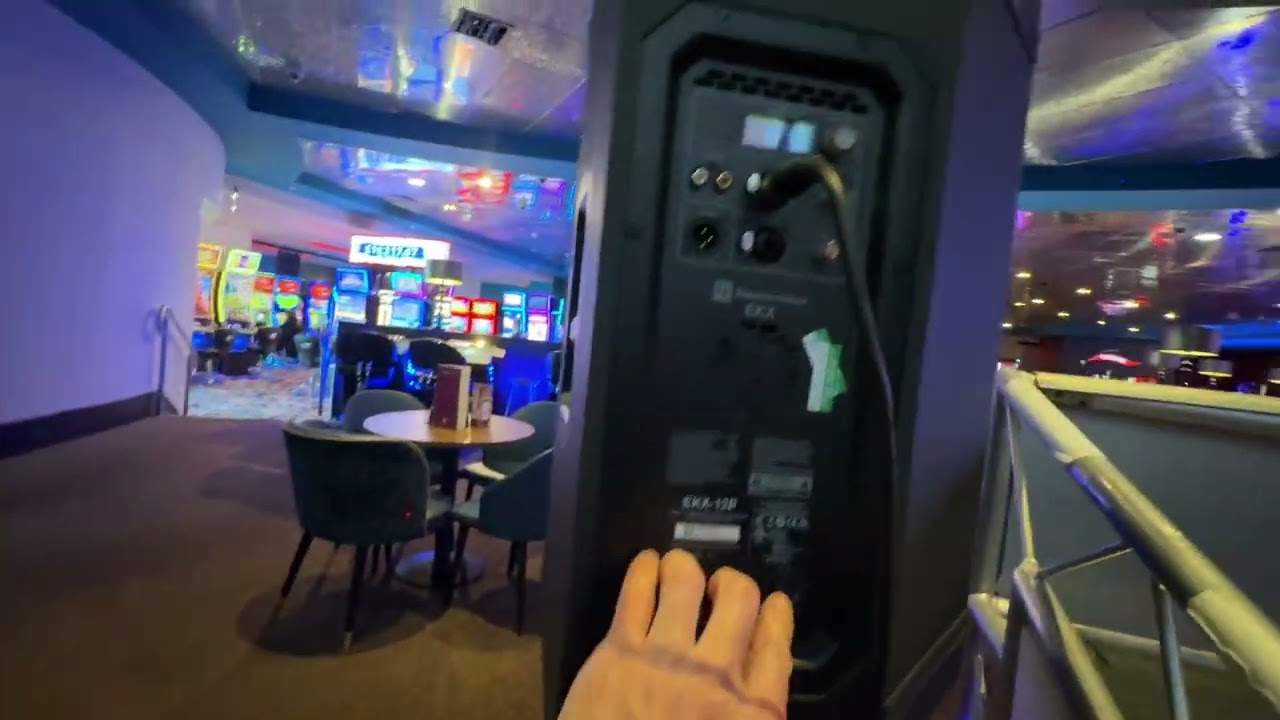
Look at the size of that compared to that guy. Okay, now this is what I want about condition-wise. Check it out. You see what we've got here is we've got the gain outputs for each channel which is near enough exactly the same as your mixer but you've got the LEDs and then logically you've got the master output there. Check this out. Custom built, spot on disco. By Matt Mathias. Now that is cool. That, on the other hand, is not cool. That is just dirty. I'm hoping I'll be able to get this working. I don't know if Johnny mentioned, but this, apparently you were able to make the sound move around the speakers because you could get four stacks. Treble, I presume. Bass. Quad pan. Quad pan and normal. You know what? They just, they don't seem so bad. What do you think? This cat's thinking, yo, this smells really cool. Let's have a look down the side here. I can't see myself. But what have we got? We've got outputs, headphones, low frequency and high frequency. Check it out. That's excellent. And then on the other side.
I mean, that's the base of the unit. I tell you what, it is so heavy! I mean, I had to get a hand getting the damn thing out. So mic input, tape, one tape two line input, fuses, mains on off. It's solid. Absolutely solid. Okay, can you imagine trying to carry that around with you? Well, you know, MP3 players today, you don't know how lucky you are. Yep, bit of a difference in size. Practice and enjoy.
This transcript was produced automatically from the audio of the video and may contain mistakes.
Related videos
-
How to Get a Better Fee for Your Mobile DJ Services
He disclaims it as not financial advice and notes that everything depends on where you are. Taken as a checklist of what justifies a higher…