 7:39
Kam Soundforce5A , Active speakers from Kam
Contents of the video
0:00 These guys
Alright folks, in this video we're going to look at these guys here. They're small monitors and they're from a company called CAM. These are known as the Soundforce 5A. First of all, before we actually have a look at them, A stands for active. Now what is active? Well, let's look at it from this point of view. You've got your DJ set up. You'll have your mixer, your CDJs, your vinyl turntables, whatever, plugged into your mixer. But quite often you'll have what's known as an external amplifier. Now that's the thing that makes the noise, so you'll have mixer, amplifier, then your speakers. Now active, when we're talking about speakers, basically means that there is an amplifier inside the actual speaker. But in this case, there's two amplifiers inside of this. I'll explain in a minute. Alright, let's have a look at the back. Right, I don't know if you can see there, but if you look at the back of your mixer,
Identical plugs to those. They're known as RCA plugs, red and white. So what you will do, you can do a couple of things. You can go out of your master output into here or you can go out of your booth output. So the reason being if you go out of the master output that basically means that these will be the main speakers for your sound system. Alternatively you could go master out into another amplifier into another set of speakers And then you could go from your booth out into these guys here. Then what will happen is these will be classed as monitors. So if you imagine, these are facing me, these are the monitors, I will be able to turn the booth up and down, that is what will determine the volume on these, as opposed to then the main output which will be wanging the public out there. Alright, like I said, active. There are two amplifiers in here. Now first of all, what have we got? We've got a volume control.
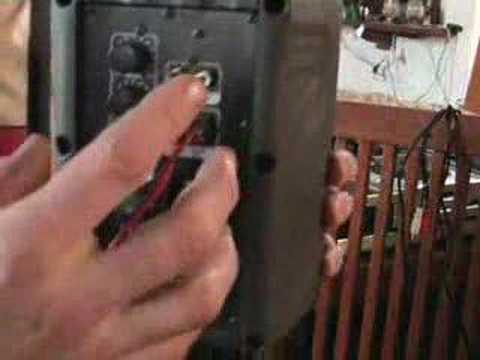
We've got treble, we've got bass. I'm going to show you what that's all about very shortly. On-off and we've got over here in the UK what's known as a kettle plug. That's it. OK, there. Can you see those plugs? What are they for? Well, what actually happens is you will get this with the speaker. Now first of all, I want to show you something that's very important and this actually does apply to any speaker. First of all, I'm just going to... Put that up there so I can see, there's a little screen there. Now can you see on that one, we've got a black line. Now what you need to do, it doesn't really matter where that goes, but what does matter is you put that in the corresponding plug in the other speaker. So if I put that in there, you can see that goes in the red one, clip it tight and then the one without an actual black line I can put in the black one, there, like so.
2:49 That very shortly
So that's fitted there, now just put that on the floor and there's the other side. And here is the other speaker. Now can you see there's quite a difference? It's a lot lighter and also there's no gubbins on the back. The reason being is there's no amplifier in this. I'll explain that very shortly. Now what we do is we take the one with the black line and we put that in the corresponding colour plug there. And then the one without the black line, we'll put that in there. Alright, why isn't there an amplifier on this one? Basically what's happening is on this particular unit or inside here, you will have an amplifier for this piece here, for this speaker. So, power in, signal in and then the amplifier in here will run this particular speaker. But also then, let's just push that back.
Also what happens, you've got another amplifier here that will take the power, it will take power from the amplifier that's in here into these two speaker cables here. And then what happens then, that then will take the power to this speaker, like so. So you will have stereo signal, you will have a stereo signal. In other words, that could be your right speaker and that one down there can be your left speaker. What I'm going to do now... Pause the camera and I'll plug it all in and we'll have a little demo. Alright, first of all, this is how it's plugged in. You can see the power lead, you've got the two cables going to the other speaker, you've got your RCA, now again, red is going into the red input, white is going into the white input. Volume, I'm going to set that about 3 o'clock. Now treble and bass, I'm going to set those what is known as flat at 12 o'clock. The reason being is because if I want to increase the bass,
5:12 What I'll do now, pause the camera again and we'll give them a demo
If I increase the bass too much on here and the treble too much on here, and then I started to increase the bass and treble up again on the mixer, you could start not necessarily to overpower these, but you could start to make them sound not very good because you're putting too much bass and treble into it. So ideally keep those 12 o'clock. Wang them up a tiny bit if you want to, but at the end of the day, you can do what you want. So what I'll do now, pause the camera again and we'll give them a demo. Alright, here we go. All plugged in, all ready to rock and roll. What you have to consider is that they will not throw out vast amounts of bass, but I suppose in a sense, you know, if you're living in a block of flats and you don't want to annoy the neighbours...
Then you're going to be a bit silly to have huge bass cabs because you're probably going to get evicted in five seconds. So, there you go. Also what we've got as well, I don't know if you can see, there's a bracket on the back of there. Now, I highly recommend this if you can, but first of all don't start knocking holes in your walls and you might get shouted at. But, if you can see, a bracket on the back. Now, the idea for that is you can fit these against a wall. Now, because I class these as sort of near-field speakers, the reason being if you stuck these about 100 metres away, you probably wouldn't be able to hear them that well. But if they're quite close to you, then you don't need them loud, you don't need them booming, because you'd have a good audible sound right next to you. Now, very quickly, a tip. Can you see there is the CD player and about there is the speaker. It's facing me at 45 degrees. Now, ideally, you need your speakers...
Head height, the reason being is you're going to get the optimum sound from those speakers. Right, how can I do this now? Right, I'll just pause the camera a second, hold tight. Right, here's the deal. If you can see now, here's my head height. So ideally we want them there. The reason being is because I've got a good sound very close and at my head height. If you're down here, down there. And you can see there's a bracket as well, so what you can do, you can either have them against the wall flat like that, so you can move them up or down. Alternatively, you can have them flat against the wall and then you can move them side to side as well. Alright, so we'll bang it on again. So there you go, there's a quick insight by a company called CAM and they're known as the Soundforce 5A. Practice and enjoy. Thank you very much.
This transcript was produced automatically from the audio of the video and may contain mistakes.