 20:03
KAM Vortex V2 Series 12", 15", 15B, 18B
Contents of the video
0:00 You have in front of you the new Vortex V2 series
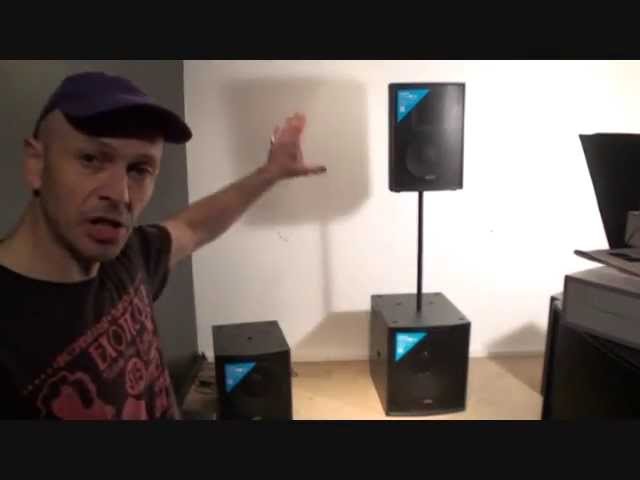
Right ladies and gentlemen, you have in front of you the new Vortex V2 series. These are from CAM, two-way passive speakers and also you've got a couple of bass cabs there as well. Top left hand corner we have the Vortex 12 V2 which is a 12 inch and a compression driver. Then next to that on the top we've got the Vortex 15 V2 which is a 15 inch and a compression driver. Below the 12 you've got a 15 inch sub and below the 15 you've got the Vortex 18B which is an 18 inch base sub as well. Here we go, it's a close-up of the Vortex 12 V2. This one here is a 12 inch. And a compression driver at the top. Now it does say it'll do 1.2k of peak power, now it will but of course the peak power is only for a very small amount of time. The actual continual power on this is 300 watts RMS and as I've said many a time in all my videos always look at the RMS. Now a cab like this is possibly suitable let's say for
The DJ Tutor is available for the Vortex 15BV2. There isn't any internal amplifier. You will have to have an external amplifier to get the sound out of this speaker. Alright, quite a nice little bit of kit here. What we're looking at as well is 600 watts RMS continual power. So that's 600 watts that this speaker will be able to push out all the time. It's not peak power, it's continual power. On the back there's two speakers. I'll show you that in a little bit. The dimensions is 510x435x540mm, weight is 35kg and what I'm going to do now is show you how you could sort of mix and match these two speakers. To the left of the bass cab you've got the 12 and horn mid-top cab, 15 inch in the middle and then what we'll do later on in the video, we'll have a look at that rather nice piece of kit on the right hand side, that's the 18 inch sub. Right, if I give you a close up first, that is the sub.
2:33 Wire these up and also good
And that's the 12 and horn. So what I'm going to do now is show you how to wire these up and also good ways of setting them up, let's say if you're in a mobile environment. Here's a quickie though, a speak-on connector. That is where you put one of them. It's not rocket science but if I show you then no excuse. On the speak-on you've got a couple of bits of plastic that protrude out from the circular area. There's a small one. And there's a big one. If you look here, that'll fit in like that. Now, you don't do that. Well, you do that, of course, but you don't leave it like that because it'll come out. So what you need to do is push in and twist. The beauty about speak-on connectors is that they can't be pulled out. And for a lot of the members of the public, they'll look at something like that and probably think it's a power supply. And if they do try and pull it out, they can't.
A lot better than your conventional jack plugs, which of course can just be pulled in and out or your XLRs. But if you want to take it out this is what you've got to do. At the top you've got that piece of metal. Pull it towards you and then twist and then pull and that's it. Right, very very simple for millions of people out there but there's probably a few who question how do you do it? I'm going to show you. Plug-in speakers. Very simple but if you don't know what you're doing It's not simple, so I'll show you. Right, okay, so we've got our speak-on connectors. If you're using, as we've got here, passive speakers, then you will need an external amplifier. So let's imagine that that there is connected to my external amplifier. There you go, it's over there. Just kidding. Right, so what I'll do first is I will go into the bass cab. So I'm going to go into the bass cab like that again.
As I said earlier, you push in and you twist. Now what we need is another speak-on connector to speak on because we've got to go from the base cab into the mid-top cab. And we do that by going into the second plug of the 15B into the vortex at the top. And that's it. Now of course, that system would be great If there was one person against the wall, and if you did turn it up and you had a suitable amplifier, they'd probably be very deaf. So I'm going to turn it around and show you a little trick, and all you need is a piece of pole. Hold on. Give you an idea of height. I'm six foot tall, so if I stand next to these, come to about there, which is around about four foot-ish, something like that. Now, that'll work fine.
5:26 It will sound perfect and you won't have any problems at all
It will sound perfect and you won't have any problems at all. But, I suppose I am contradicting myself because you will have problems. If you've got say an event and you've got 100 people on the dance floor, then the sound, especially the mid and the top high range, will start to disappear because the sound will be absorbed by the crowd. So anyone behind sitting down... We'll probably, well, they'll be able to hear something but it'll be quite a muffled sound. For some people they'll like it because a lot of people who are sitting down don't really want to dance and they don't want to listen to the music. Most of them, well some of them. But how do we get around making it sound better? I'll show you. Right, what I'm going to do, I've unplugged the speak-on from the 12 inch and I'm just going to put that on the 18 and I've got one of these.
It's a Darth Vader kind of thing, but doesn't shine. It's a pole! There we are. And again, just think outside the box here. What we're going to do is put that into what's known as the top hat. Now if I was to take that out of the speaker all it would be is a cylinder turned upside down where the pole sits in. That is it. And then what I can do is put the 12 inch speaker on the top and this is a bit awkward, but... When you've been in this job for a long time, you get used to it. There you go. Right, let's go and stand by it now. So, I would say that's just about perfect for a mobile gig. And also, it takes your PA, yes, to the next level, but it looks better. And trust me, it will actually sound better as well. Now then, tip for you.
7:18 There are lights out there that you could probably attach to that
There are lights out there that you could probably attach to that. Or other things, or maybe a rope light you stick around it. Just use your head. Or maybe even you could get some form of cloth attachment and have it at the top here down to your bass speaker. It will do a couple of things. One, it will stop people being able to see the pole and the cable you've got up because you'll have the cable for your mid-top. The other thing, if you've got some form of cloth there, you could put maybe some LED lights behind it and have them shining. So you've got a speaker, shiny lights and another speaker. Again, a small tip for you. We're coming out of the bass cab and two ways, well there's actually quite a few ways, but the two main ways of plugging in to your mid-top. One is like that. There you go. And I don't know if you can see, actually you probably can't see from here, it's well hidden.
But there's the cable, it's just dangling around and it's in the way. And if you want things tidy and professional, it probably doesn't look that good. But what we can do is if I just pull that out and go around here like so. There. Now that will look a lot better if you've got some form of cloth in front of you as well. Trust me, it's probably very difficult to see on video but... Something like that is far better than having a cable dangling behind the speaker. Alright, so we'll pause the camera now. That's the 15 and the 12 inch. We'll have a look at the big brothers. I've got to the left hand side the 15 just in the video to give you an idea of the difference in size but right in the centre we've got the big daddy. It's the Vortex 18B V2. This one here is high quality bass PA speaker
10:29 Don't put those on the floor
There you go, pretty simple how we like it but if you are using a mid-top cab Then you'd go from your amp into the 18B, and then out this side into your mid-top cab. Just exactly the same as the 15 and the 12 I showed you. So we've got the rather nice 18 sub on the bottom, and that one there is the Vortex 15V2. It's a two-way passive speaker. This baby will handle 350 watts continuous RMS. Pretty heavy, it's 21 kilograms, around about half the weight. If you're just going to use Fifteen and Horn by itself, I highly recommend you use a set of tripods. Don't put those on the floor. If you do, like I said earlier in the video, if you've got two of these just sat on the floor, as soon as people start to come in and dance, the sound's going to get muffled. So they must be, they've got to be head height. Right, I'll be honest with you, even though I'm demoing these products for you, what I'm trying to do...
12:22 Couple of things
The DJ Tutor is a great way to learn how to use the DJ Tutor app. The DJ Tutor is a great way to A lot easier than having to pick the speakers up and manhandle them. And first of all, what I'm going to do is we'll take the 15 off the 18-inch sub and get the 12. I'll be honest with you, what I would personally do, this is my own personal preference, if I was going to buy the 18, I'd be more inclined to put the 12 with the 18. And I'll explain why in a little bit. So if I put that there, like that. There you go. No. Sorry, I think it was the boss, he just sort of like, I turned around and there he was and scared the living crap out of me. Sorry. That was, it was actually more funny than scary. Okay, so I'm going to explain a couple of things. Now first of all, these product reviews are, of course they are product reviews, but also what I'm doing is hopefully giving you a little bit more information on how to set up your PA system to get the best possible sound.
Now, 18 and 12 and horn. I would personally use this kind of system. There's actually no need to have a 15 and horn on the top of an 18 because the 18 would almost, it would be working, it would do a bloody good job but you're better off having a 12 and horn. The 15 and horn would be ideal let's say by itself or four of them or if you are going to use 15 and horn then you want to start looking at an active crossover as well. I'm going to go technical here, but I'm not going to go too technical. Now a system like that, 18 and a 12 inch, you can use in many ways. Now just imagine we've got an imaginary stack exactly the same as that. So there's two 18s, two poles and two 12 and horn. You have one amplifier, four ohms aside. And of course, check...
The power rating of your amplifier. I'm just saying amplifier, I'm not telling you what power of amplifier you should get. So just imagine we have an amplifier, 4 ohms a side. What you do is you go from one side of your amplifier using a speak-on connector or whatever connector is in your amp into a speak-on connector which will plug into your bass cab and then you'll go from the bass cab using a speak-on connector into your 12 and horn. And that's pretty much it. So of course if your amplifier is 4 ohms 4 ohms, sorry 8 ohm speaker and an 8 ohm speaker connected together in the correct manner will give you 4 ohms which will be suitable for that amplifier. But how do we make that sound sound a lot better? And you can do it. Even though you're using the same speakers you can actually make them sound even better
15:02 You'll go from your mixer into your two-way crossover
By using an active crossover. So, imagine you've got your CD player or your music source into your mixer. From your mixer you will go into an active crossover. Now ideally you just need a two-way active crossover. The two-way active crossover will separate the sound from the whole array of sound into two parts, low and mid and high, or low and then high. You'll go from your mixer into your two-way crossover. From your two-way crossover, you'll go into two separate amplifiers. The one amplifier will give you the bass, the other amplifier will give you the mid and top. Now on a two-way crossover, on the back of it, you should be able to see four outputs. Two for low and two for high. So the two low will go into the left and right hand side of one amplifier. The two high will go into the left and right of the other amplifier.
And then all you need to do is go from your amp into the bass speakers and then from the amp that's having the mid-high or the high sound into the top speakers. Now again, if your amplifiers are say 4 ohms a side and you're going into 8 ohm speakers, ideally this is where we take it to the next level. It's probably a good idea to get two bass cabs either side. We'll bring it down to 4 ohms. If your bass amp is 4 ohms, then it means you'll be pushing out the correct amount of power. Exactly the same for mid and top. If your mid and top amplifier is 4 ohms, and you've got four of those speakers, then you'll go from one side of your mid and top amp, 4 ohms, into one of the 12-inch at 8 ohms, out of that one 12-inch into the other one at 8 ohms,
Two eights brings it down to four, which will work perfectly, but again you need to make sure that the amplifier is the correct power for your speakers. Now again, you can go on and on about things like this, but if you are a bit of a junkie that wants beautiful, pure, good quality sound, then you have to look at things like this. There's no point going to a shop and saying, right, I like the look of that amplifier because it's got flashy lights, and that speaker looks good because it's got horns on it, and I just want to buy them. It's not like that at all. You need to make sure that everything matches perfectly because you could spend a vast amount of money on a PA system that looks wonderful, but as soon as you plug it in, it might start to bang, pop and whiz.
17:33 In fact, if you start at the drawing board and work your way up
Because the ohms aren't correct, maybe the amplifier is too powerful for your speakers or maybe the opposite. The speakers are fantastic, a thousand watt speakers and your amplifier is 100 watts and you think I'm not getting some proper sound here, I need it louder. You turn your amplifier all the way up. You then still realise you're not getting too much sound, or enough sound, you turn your mixer all the way up, everything's in red, and before you know it, you've blown your speaker. And it can be done, even though your speaker is a thousand watts and your amplifier is only a hundred. If you start putting what's known as a square signal into your speakers, which is basically electricity, you're going to knack your speakers, so you might as well go back to the drawing board. In fact, if you start at the drawing board and work your way up...
You can't go wrong. Alright, so I'm going to pause the camera now. Get a glass of water or something. Right, we're not all built like Arnie Schwarzenegger, so if you are, let's say, a little bit weak at the knees, how can you get a speaker like that on top of a bass cab lifted up? Now there is quite an easy way of doing it, but again, you need to make sure that you don't scratch your speakers. Alright, admittedly they will get scratched over time, but of course the more you look after them, the longer they'll last and the more they'll look after you. They might cuddle you at night. Right, what I'm going to do, I'm going to take this off. This is the 12 and horn and I'm going to put that down there and take the pole out. We'll do this in real time. You'll see exactly how it's done. Right, there's my bass cab. Now let's imagine that, and this is, it's not important but it will help. It's one less move you've got to do. Right, I'm going to face my bass cab that way.
Because that is my imaginary dance floor, that's where the people are and that's where I want the sound to go. So I'm going to turn this like that. I'll just bring it over that way a little bit. What I'm going to do now is I'm going to put my pole into the speaker. Actually I'll bring it there. Like that. And then I'm going to get my 12-in horn and I'm going to put that in like that. Now at this point here... I'm not going to let this drop. I can if I want to, but then it's going to put a lot of pressure on the internal parts of the speaker. Now what I'm going to do is just lift up like that. There you go. Alright, you're still going to have a little bit of muscle, but it's far easier than lifting the 12-inch on the top. So there you go. Right, Vortex V2 Series. What I'll do is I'll put a link in the description.
Take it directly to the CAM website, so practice and enjoy. I do, thanks.
This transcript was produced automatically from the audio of the video and may contain mistakes.