 4:46
Tri Phase from American DJ LED Light
Contents of the video
0:00 It's from a company called American DJ
Alright folks, video here on this guy. It's from a company called American DJ. It's known as the Tri-Phase. It is an LED light. Now I don't know if you can see but I've got all the lights on in the room. I've got that guy on and I've got a bit of smoke out. The reason for having the lights on, a bit of smoke and the light on here in a room that's got its normal lights on is to show you how this guy can cut through smoke even in a room with Lights on. Yeah, okay. I mean at the end of the day it would be so simple for me to turn all the lights off, have a bit of smoke and you'd see how wonderful it is. But sometimes it's quite good and it also shows you how bright a light is by using it let's say in broad daylight or in a situation like this. Now what I'm going to do, I'm going to pause the camera and have a little look around it and then we'll put some music on, turn the lights off and see exactly what it looks like when it's pitch black.
1:29 This is known as a heat sink
I'll link another video to this showing you a whole bunch of these guys at the Mobile Beach Show in Las Vegas, so just pause the camera a second. Right, there you go, that's a side view. To give you an idea of size, that is a CD, so one, two. So it's not drastically huge. Now if we have a look at the front of it, we've got an area, I don't know if you can just see that. Well that's... This is known as a heat sink. What that will do, it will help disperse the heat from the LEDs. Now bearing in mind, LEDs do not get drastically hot so don't panic. Let's just have a look at the back of it. Alright here we go. Now this guy is quite user friendly. There's lots of different ways you can use this. Now first of all, input for power. Notice we've got male and female power.
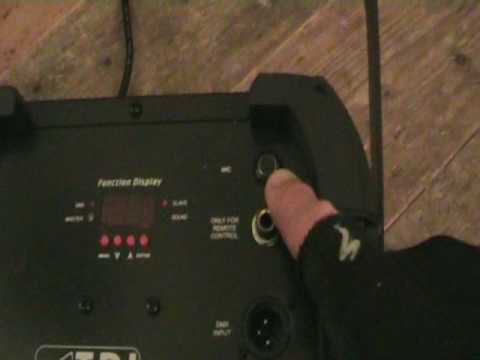
Now basically what we can do, we could go into this unit, but then also we could do what's called as daisy chaining. We could go, let's say, out of this unit into another one. So in other words, instead of having, say, a four-way and having one of the four ways into this, another one of the four ways into the next one, you could go from one four-way into this, then out of this one into the next unit. OK, we've got these guys here which is basically for DMX purposes. You have input and output. This guy here is for your remote. Now this unit here is the microphone. Basically what that's there for, that will pick up the sound enabling the unit to do sound to light. Also, that's ideal for master-slave. In other words you could set this unit to be the master and then you would go from this unit to the next one exactly the same and then that would be the slave. So in other words this guy here would be the one picking up the sound
3:31 At the moment, the unit's basically set from sound to light
And then whatever this one does, the other one will do. Also, function display. Now basically, this is almost the equivalent of having its own personal DMX controller. In other words, you know, you can set it to do its own little thing by using this guy here. Now what I'm going to do, I'm going to turn all the lights off and we'll put a bit of music on and we'll see exactly what it looks like in the dark. I'll put the name of the track to the side of the video in the description along with any relevant links. At the moment, the unit's basically set from sound to light. So in other words, the microphone will pick up the sound from the speakers and move accordingly. So there you go. And again, tri-LED. Red, blue and green. I mean, where is it going to end? It's all very exciting times here.
Thank you for watching.
This transcript was produced automatically from the audio of the video and may contain mistakes.