 12:45
Choosing speakers for DJ, PA or band use
On YouTube this video is called Advise on what Speakers to get. PA, DJ, BAND, ACT
What this lesson teaches
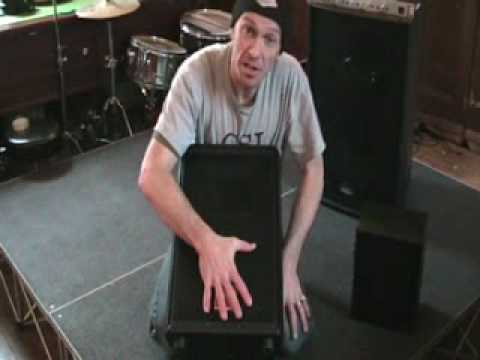
The longest equipment lesson on the channel, and it is the one to read twice. He works up through four levels of system, with the actual boxes in front of him.
Level one: powered monitors
For a bedroom DJ, his advice is straightforward: do not buy a big amplifier and big speakers. Buy powered speakers.
The back panel of one: mains input and switch, a signal input that will take jack, XLR or RCA, a volume or gain control, and a treble level.
The reason powered speakers are safer
This is the single most important sentence in the lesson: the internal amplifier matches the speakers precisely, in ohms and in power.
The manufacturer knew what drivers were in the box and specified the amp for them, which takes most of the guesswork out of the pairing.
With separates you can get it wrong in two directions:
Too powerful an amp can blow the speakers - the obvious failure, where more power arrives than the voice coil can dissipate.
Too weak an amp can blow the speakers too - and this is the one that surprises people. An underpowered amp driven to its limit clips, and a clipped waveform is closer to DC than to music. It dumps heat into a tweeter or compression driver that is expecting an average, not a sustained square wave. Compression drivers die of clipping far more often than of power.
So the honest summary is that both mismatches kill speakers, and the practical defence is headroom: an amp comfortably bigger than you need, run well short of its limit.
Level two: the ohms worked example
He holds up a 10-inch-and-horn cabinet rated 500 watts at 8 ohms, and an amplifier rated 500 watts at 4 ohms.
The assumption everybody makes: plug them together and get 500 watts. Wrong. The amp makes 500 into 4 ohms; into 8 ohms it makes substantially less - roughly half, depending on the design.
To get the amp's full output you need the load to be 4 ohms, which means two of those 8 ohm cabinets per side, connected through the link socket on the back of the first one.
And now the arithmetic turns around: two 500 watt cabinets can take 1000 watts, and the amp makes 500. You have gone from underloading the amp to underpowering the speakers - back to the clipping risk above, if somebody turns it up to compensate.
Level three: matching properly
The clean version. Two 500 watt, 8 ohm cabinets per side present 4 ohms and can take 1000 watts, so you want an amplifier making 1000 watts a side at 4 ohms.
But he takes it one step further, and this is the part worth internalising.
An amp running at exactly its rated output is working hard. Better to buy one rated 1200, 1300 or 1400 watts a side at 4 ohms and run it well inside its capability.
The car analogy
His illustration, and it is the right one. A 1.5-litre car at 70 miles an hour is screaming. A Porsche at 70 is idling.
Same speed, completely different stress on the machine - and the one that is idling will still be working in ten years. That is what headroom buys: not volume, but the same volume produced calmly.
Level four: adding bass cabs
When a 10-and-horn or 15-and-horn runs out, the answer is bass cabinets rather than more of the same.
If you have one amplifier, buy bass cabs with a passive crossover inside, which strips the mid and top out of the bass box and the bass out of the mid-top - so one amp can feed both without a separate crossover unit.
If you have two amplifiers, use an active crossover - the rack unit he shows at the end - which splits the signal before amplification and lets each amp drive only the band it is responsible for. That is the proper way, and it is covered in full in the two-way system lesson in this course.
His own benchmarks from using them: 15-and-horn cabinets will do a function of around a hundred people; modern dance music with real low end wants 18-inch bass cabs underneath them.
His closing instruction
Do not buy anything and everything and then wonder why it does not work. Look at the ohms, look at the power, and look at the build quality - in that order, because the first two decide whether the kit survives and the third decides whether it was worth buying.
Contents of the video
0:00 Speakers, ohms, amps, that kind

What? Hi. Right, this video we're going to look at speakers, ohms, amps, that kind of stuff because everyone's always asking me what speakers should I buy, what amps should I buy for what speakers etc. Now I have done a few videos on this subject in the past but of course the more information I can get in there the better. Now this video is targeted for virtually everyone who wants speakers whether you just want them for your hi-fi Maybe you're just a bedroom DJ and you want a couple of monitors. Maybe you're a duo, you're an act, you're a comedian and you want a couple of speakers so people can hear you, a roadshow or maybe even you want to do some big PA systems. There's a lot of relevance in this video for absolutely anybody out there. Now first of all, let's say you're just a bedroom DJ and you want a couple of speakers. Well, in my eyes, it's no point having huge amplifiers and huge speakers.
If, let's say you want a small sound because you've got neighbours that you can annoy, then look at some powered speakers. Now first of all, powered speakers will have amplifiers inside them so there's no need for an external amplifier. So in other words, you will go from your CD players into your mixer, out of your mixer, into the powered monitors and let me show you one. I'll put all makes and models in the description. So there you go, there is a powered speaker. And if we have a look... Let's just move that so I can see what I'm doing. That there is for the power input, on-off. This guy here is basically for the input and we can go three ways input. We can have VAT there which is a jack input, we can have XLR or we can have RCA. This guy here is the volume sometimes known as a gain control and this one here will just basically increase or decrease the intensity of the treble speaker.
2:25 Very shortly

Now, one important factor about this guy here. Internal amplifiers match precisely the speakers ohms-wise and amplification-wise. So that is so important because sometimes people will buy an external amplifier that is too powerful for the speakers and they can blow the speakers. Alternatively, sometimes people will buy an amplifier that isn't powerful enough for the speakers. Guess what? They can still blow the speakers. You're probably wondering how or why. I'll explain very shortly. Right, I'm going to put that there. Now this guy here is an amplifier. It's a power amp. It's very heavy. There are new amplifiers out. I'm going to be demoing some very shortly that are called switch mode. A lot lighter and quite often the sound quality is a lot better.
This is powered. This is from a company called Gemini, so it's the GX1001. It's a powered speaker. Look at the back, you can see their heatsink. And there's all relevant plugs and knobbly bits etc. This sort of speaker can be used, let's say in your bedroom for monitoring. But also, because it's a lot bigger, the bass speaker here will be able to produce louder low frequency sounds as opposed to the smaller speaker. You could theoretically take this on the road with you to small functions. But if I was to take this, I would not take a speaker like this. To say a function of two or three hundred people, because you'd be cranking it up so loud it would sound atrociously atrocious and you'd probably end up knackering it. So in a sense this is great for say like 50 people, something like that. You would not use this for anything higher, you'd be silly to. But you could use something like this if you used say this in conjunction with a set of bass cabs, because then the bass speakers would be taking all the low frequency
4:57 The DJ Tutor is available for purchase at Ellaskins.com

And you wouldn't have to crank these up so much, so I'll put that to one side. Said the bishop to the actress. Right, this guy here is a non-powered speaker. There it is. It's from a company called Intimidation, 10 inch and a horn. Now this guy, this is where we get the ohms bit. This speaker here, make sure I'm 100% correct, yes, is 8 ohms. Now let's imagine that amplifier over there, which it is. The DJ Tutor is available for purchase at Ellaskins.com. At 4 ohms. So this one is 500 watts, full stop, not a side, this is 500 watts. So people automatically think that if I have this plugged into that amplifier, I will get 500 watts. Well you're wrong, you won't. Because it's 8 ohms, it will not produce the full 500 watts.
Now again, stick underneath here a comment. There is a mathematical formula how you can work out precisely how much the speaker will produce but you will not get the full potential of the amplifier from the speaker. What you need is you would need let's say the speaker to be 4 ohms. Now if this speaker was 4 ohms at 500 watts and that amplifier was producing 500 watts at 4 ohms, then you will get that power. To enable you to get the full potential, you would have to have two of these. Now this is what you'd do. You would go from that amplifier to one of these speakers, out of one of these speakers into another speaker. Now what we've got is we've got this sort of dilemma. We go from one 8-ohm to another 8-ohm speaker producing 4 ohms.
7:43 We have two speakers at 1,000 watts

But if this one was 500 watts and the other one was 500 watts, we could theoretically have a thousand watts. But because the amplifier is only 500 watts, it means that we're underpowering the speakers, which is what I said earlier. If the amplifier is too low and people start cranking the amplifier up too high, you could theoretically start to knacker speakers, even though the amplifier... Ellaskins, The DJ Tutor. I know I waffle but hopefully you'll see and understand step by step where I'm going. Now ideally if this speaker was 500 watts at 8 ohms and you had another one 500 watts at 8 ohms giving you 1000 watts at 4 ohms then you would need ideally an amplifier 1000 watts at 4 ohms. But this is where we get to the next level.
We have two speakers at 1,000 watts. Now bearing in mind this is only one side because it would be a stereo amp. So in other words, 1,000 watts one side, two speakers 500 watts each, 1,000 watts the other side, two speakers 500 watts each. Now again if you think about it those speakers will quite happily run 500 watts each, 1,000 watts. The amplifier, 1000 watts aside. But because the amp can only run at 1000 watts, by the time you get to its limit, which is 1000 watts, the amplifier might start to work too hard. So again, taking it to the next level, it may be advisable to look at an amplifier that can say work at 1200, 1300 or 1400 watts aside at 4 ohms. Because what's happening then is the amplifier is just ticking over nicely. It's almost the equivalent of, let's say, having a small one and a half litre car that when you run that at 70 miles an hour it's going to... Like that. As opposed to a Porsche 911 Turbo Carrera, you run that at 70 miles an hour, it'll go... It'll just tick along really nicely. Now, that there is a 10 inch...
11:01 Next level
This is ideal for small functions but you would not take this to a big event. You'd need bass cabs. Ok, now again we're getting to the next level. I'm going to try and cut this short now otherwise I'm going to run out of time. Now if you've got one amplifier and your amplifier is 4 ohms a side and let's say hypothetically your amplifier is 1000 watts a side then maybe you need to consider having some bass cabs. Now, if you've got one amplifier, if you want to buy bass cabs, then try and get bass cabs with what is known as a passive crossover inside.
Now the passive crossover will eliminate all of the mid and top from the bass, giving you just bass in the bass speaker, and then what it will do, it will take away all of the bass from the mid and top, so in other words you will go from your amp And a couple of bass cabs. So, for small functions you could use a couple of these. For bigger functions you could use the bass cabs in conjunction with these. Now again, these are 10 and horn. Alright, let's go to the next level. Now that guy there is from a company called Cam. It's a Vortex series. 15 and horn. Now I have used these as well. I've used speakers like these, 15 and horn, in functions, let's say up to about 100 or so people.
And they will work. But again, the trouble is when we look at modern day dance music with loads of bass then even items like this may not be good enough. Maybe you do need bass cabs but if you're going to use 15 and horn then maybe you need to consider using 18 inch bass cabs. Now let me just show you something like this and then we'll pack this video in. Now that guy there is a crossover. It's known
This unit will let you run two amplifiers. This unit here will take all of the bass out of the mid and top and vice versa, enabling you to run two amplifiers and loads of speakers. Now if you want any more information, put it in the comments, etc., just tell me what you think. Hopefully this will teach you and inspire you a little bit. Most important, okay, don't start buying anything and everything and then wondering. Look at ohms, look at power, and maybe look at quality of speakers as well. Practice and enjoy.
This transcript was produced automatically from the audio of the video and may contain mistakes.