 9:45
Do you need a big pa for your GIG Mr DJ????
Contents of the video
0:00 Had an email from a YouTube user and it got me thinking
Alright folks, had an email from a YouTube user and it got me thinking. Right, basically they've got a night on and they're playing to a crowd of I think it's about 700 people. Now they were going to get small PA but the thing is with regards to PA you've got to remember this particular philosophy and that is you can turn a small PA not up. But you can turn a big PA up as loud as you want, but you can also turn it down. Whereas a small PA, you can't turn it up. So if you're playing let's say and you're hiring gear and you've got a thousand people, it's better to have something that will blast them as opposed to getting something. That halfway through the night they'll be basically saying, right, turn the blinking things up. Now then with PA systems, like I've said before, you've got a box standard speaker. Now if you look at it like that, what we're looking at there is a relatively box standard speaker. That's your mid and bass and that's your horn. That is the thing that gets out all the treble high frequency.
2:15 You wouldn't get much bass out of a 12-inch speaker in a big room
What you find is that a speaker like that, with that particular driver there be 4, 8, 6, 12, 15 inch and this here be a small compression driver or just a general horn that will throw out a lot of treble. What you'll find is that something like that will do for your bedroom, will do for a small PA, small setup, vocals, cabaret act etc. But when you get to big PA systems, that's when these things are good but they're a bit of a waste of time. Now this sort of item, let's say for example this was a 12 inch plus a 1 inch. Now what I mean by that, 12 inch is this one here and the 1 inch is that one there. Now, a speaker like that, if you've got two of them on either side, that would quite happily do, say, a crowd of 50 people. That's it, alright? Now, you wouldn't get much bass out of a 12-inch speaker in a big room. Now what you have to consider is that a 12-inch speaker in a small room, the bass will travel quite nicely in that room and it will sound quite nice. But as soon as you put that in a big room, it will disappear and it's gone.
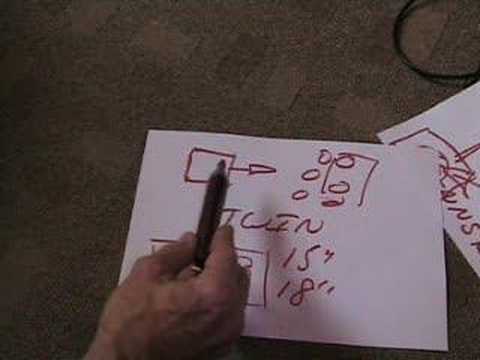
Now then, but hold tight because there is light at the end of the tunnel. Now then, let's say for example we've got our same speaker there. That's the 12 inch, that's the horn. Like so. So 12 inch and a 1 inch. Okay? Now what we would do for a medium sized sort of PA whereby let's say we are playing to let's say 100, 150 people, a pole. Check out Brian S. Redd, B-R-I-A, sorry, N-S-R-E-D-D. OK, check him out. Alright, there, and then, sorry Brian, I'm going to have to put a bass speaker underneath you mate. And then what you would have is a bass cab, there. Now then, this guy here would either be a 15 inch or an 18 inch. Now what happens is you've got a lot of bass out of that, so what was happening...
Basically, excuse the pun, is that you have all the boom-boom sound out of there and then the mid and top out of there. So now what you've gone, you've gone from something that can only say supply 50 people to something that can supply over 100 people but only supply over 100 people. Alright, and I mean only. Now then, from that, what you'd be looking at then is something like this. Now these guys here are twin, 15 or 18 inch bass cabs. Okay, now we're getting slightly more technical here because bass of course is omnidirectional. Now what omnidirectional means is that it doesn't matter whether, let's say for example, here's the bass speaker like that and the bass is going that way. Alright, now then, if your crowd are here, there's all you people dancing like so.
4:50 You have to have that pointing at the crowd
Now it doesn't matter if that bass speaker is facing that way, that way, that way or that way because the bass will hit those people irrelevant of which way that specific bass driver is pointing. But when we get to mid and top, mid and top as in this guy here, excuse me, is not omnidirectional. You have to have that pointing at the crowd. Now, the reason I've done this particular video is this. Let's say you've got a crowd of people there. That's all your people, alright? That's a sea of people. And you have, OK, you have your bass speaker there, which is fine because remember, bass is omnidirectional. It will go all over the place. And you have your bass speaker there. So you have right bass.
And left bass. Now then, this is where it gets slightly more technical but hopefully quite logical. Excuse me. Right, now then. Let's say for example you've got two speakers there which are mid and top. And those speakers are actually situated on poles, okay, on your bass cabs. Now then, the way sound works is that those speakers would be fantastic there. Absolutely brilliant. But all those people in the middle there will get absolutely nothing at all. They'll get bass, but they'll get no mid and top. Now then, there is something called trapezoid cabinets. And they are basically shaped like that. Now the reason they're shaped like that is down to the shape. Now then, think about it. Let's say we're just looking now
7:22 All of that area is supplied with mid and top
At the left side. So all of a sudden now, this is the left side. There's our sea of people on the left side. OK? Now then, we've got our bass cab here, like so. Bass. Now we've got a trapezoid cab situated there. Now that trapezoid cab, mid and top, will supply that crowd like so. But if we then add another one, here. And another one here. Then, look, look what happens. See? All of that area is supplied with mid and top. Now the likewise supply is totally relevant for the right hand side, OK? So, when you've got a big crowd, and you've got your bass cab there, and your bass cab there, like so, alright? Ideally, you will need, when I say big crowd, anything really over 200 people. You will need, it doesn't matter if they're not trapezoid by the way, okay? Even if they're square, like so. Because all you've got to do is have one facing that way, one facing that way. One facing that way, one facing that way. Because the bass will go all over the place and this sound will do that.
That's exactly what it will do. Over the carpet as well, marvellous. There you go. So if you look at that, you've got full audio all over this area. And remember, there's your people, there's your punters. Alright? So, very quickly, the whole reason for this video is this, alright? Think on this philosophy and policy. If you want to play and you think you've got enough PA for a big gig... If you've got a couple of bass cabs and a couple of mid and top, then I highly suggest you either invest in a few more or you hire some because this is the because. Halfway through the night they will be asking you to turn it up and if you turn it up there's a very good chance your amplifiers will get very hot
Your speakers will start to overheat and God knows what, and you'll blow your speakers. Alternatively, if you've got enough speakers for the punters out there, it means you don't have to turn everything up. Everything will be ticking over nice and smooth, and the punters will be happy, and you'll be happy because nothing will break and blow a knacker, alright? I hope this has been a help, alright? Practice and enjoy.
This transcript was produced automatically from the audio of the video and may contain mistakes.