 5:09
The baby scratch, 2 or 4 moves??PLEASE READ DESCRIPTION!
Contents of the video
0:00 I actually said it was four moves
Alright folks, Jonathan here. You may be able to help me with this and if you can then bung your comments and what not underneath this video. While I was in the States I showed Brian S Redd how to do something called, the terminology is the baby scratch. Now I actually said it was four moves. Now I'm a little bit confused here because I mean I basically work on logic. So... Some, there's one person who said no it's just two moves. Now I'm not agreeing and I'm not disagreeing but maybe you can help me. Now first of all I want to show you my logic how I interpret it as being four moves but then again quite possibly yes it could be two moves. Okay very confusing now I'm going to pause the camera and we'll do my sort of dodgy diagrams and hopefully I will be able to explain where I'm coming from. Hold tight. Right first off
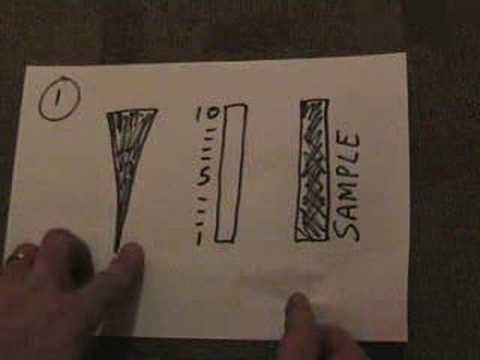
Yes, I know it looks really silly. There's our sample. Now our sample that we're going to sample, that we're going to cut, scratch, whatever, could be one second, half a second, ten seconds long. Here is the volume control. Now bearing in mind at the moment I'm not talking about the crossfader, I'm talking about the volume control on a mixer that you have to move like so. Now here is our sound or the sample From 1 to 10. In other words, there it is quiet, virtually non-existent at 1. And here it is increasing in volume as the DJ will increase the slider. So for example, I've got my hand on the record and I'm moving the slider up. As I go forward like so, in one move, and then come down in another move, what we basically get is we would get...
1:47 The sound of this sample increasing as I increase the volume
The sound of this sample increasing as I increase the volume. Therefore, there's the sound, there's the sample increasing. Now the reason I'm saying this is four moves is because what you have to do to get the full extent and the full sound from the entire sample, you would have to move the volume up, then move that entire sample forward, Bring that record, the sample back. Now that to me is very logical. If we did two moves as in forward and back, we would actually get the sample in its entirety at volume number 10, at the full volume, but we would not get the beginning of the sound because the volume would be quite low. Now admittedly on a lot of DJ mixers you can set the curve even on the volume as well.
But you would still get a slight increase to begin with, unless of course you had a curve like this. Now again, if you're familiar with curves on crossfade, you'll see where I'm coming from. Now let's say this is a crossfade and the DJ has got, say, the actual dial, the bit that he holds, fader. The buttony knobbly bit, I'm just being a bit silly here, I do beg your pardon, here like so. Now then, a lot of features or one of the features on crossfade is you can set the curve. Now quite often you will see a DJ just moving it slightly because they'd only have to move it slightly across to get the full sound but even then the curve is set here which is the equivalent of the volume going up like so. So there is the volume.
3:38 In other words it was an on-off
That DJ, excuse me, the only way that DJ would be able to basically do that in two moves is if the curve was flat. In other words it was an on-off. And how you can do that is on some mixers you've got a button. You have phono and line. And there's your button like so. And what happens is the button will move phono and line. So in other words you've got a switch. And that's it. It's basically a cut on and off. There's no volume, it doesn't increase or decrease, it's just on-off, on-off. From line to phono, phono to line, it depends on if you're scratching on a CDJ turntable, you would be using line, or a vinyl turntable, you would be using a phono. But then again, some phono vinyl turntables do have line outputs as well.
So there you go, there's my idea. I want you to expand on this if you can maybe put some more information into it etc. If you are a turntablist then please leave some comments. Let me know your thoughts because I'm a firm believer that if you have, to me it's logical, if you have a mixer whereby you've got the volume controls, you've got a sample whether it be 1, 2, 10 seconds, you've still got to move the volume up. To get the full sound of that sample, and then you've got to move the volume down to bring the sample back. So 1, 2, 3, 4. That's why I say it's four moves. I hope that's a help. Practice and enjoy.
This transcript was produced automatically from the audio of the video and may contain mistakes.